Type2


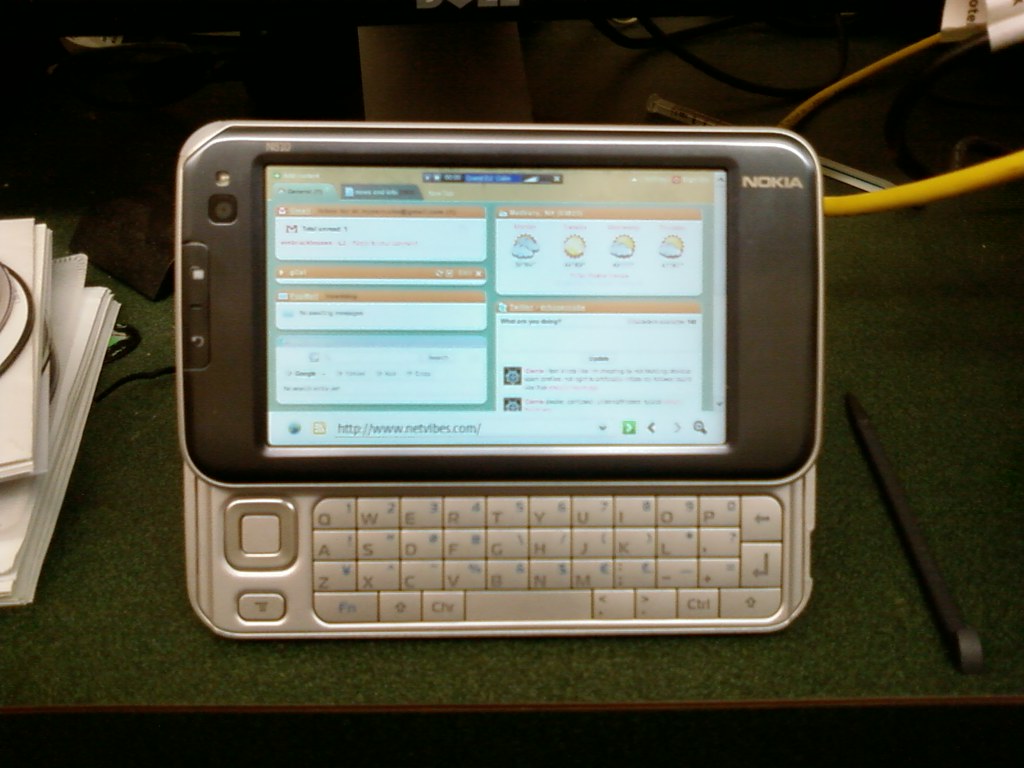
I’ve been pretty pleased with my little Nokia N810 so far. It’s fit in well as a secondary/companion device - web access (almost) anywhere, navigation and media playback. Tnere’ve been a couple nagging gaps, though…

- Podcasts. I’ve yet to figure out if it’s possible to subscribe to podcasts in an iTunesish way. It looks like you can kludge your way through with RSS, but not easily or conveniently.

- Weather. There’s a nice looking weather app (omWeather) available, but I can’t get it to install. I’ve made the N810 take the red pill (Nokia-speak for loosening some of the controls) without success.

- Twitter. There’s (again,as far as I can tell) no stand-alone Twitter client for the N810. Reading tweets on my cell phone is no big deal, but I just haven’t acquired the numeric keyboard texting skills that I guess I need. I could always go to the Twitter web site, but I’d really like something more like the Twitter widget in Netvibes.

Eureka! I’d been thinking about putting a Nokia-optimized Netvibes page together, and yesterday I finally got motivated to do it.

Weather? Check. Twitter? Check.

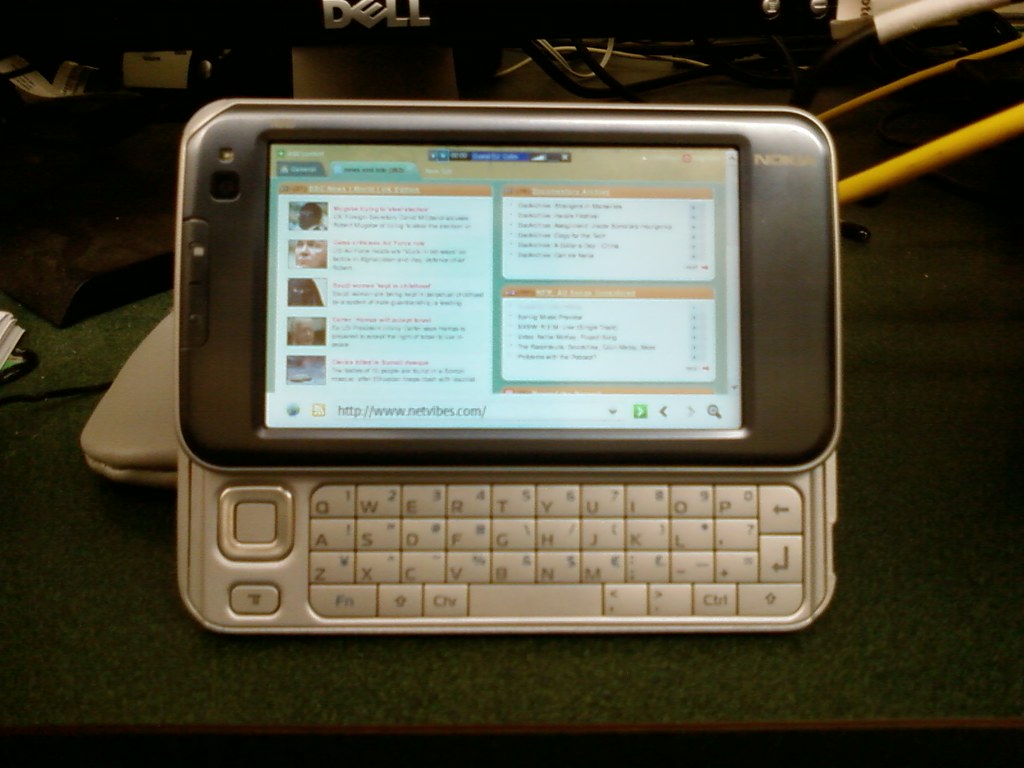
Podcasts? Sorta-check. The small toolbar at the top of the netvibes page is the built in player. I can listen to The Onion Radio News so long as I have a net connection. It’ll do…

Now, if I can just get this self-charging hack to work, I’ll be sitting pretty.

Note - N810 + Wordpy + cell phone camera + texting-photos-to-Flickr = completely moblogged post.

Technorati Tags:

As I’ve mentioned previously, I’ve been doing a bit of thinking about how technology - in particular, networking - has been changing ’stuff’ and how we acquire same. First, a couple caveats. This applies only to parts of the world wealthy enough to allow big pieces of their population to stop worrying about starving or dying of malaria/diarrhea/etc. - too often, these sorts of posts ignore the fact that there are a huge number of people who don’t worry about Mac vs. PC; they’re worrying about bad water vs. civil conflict. Also, I’m going to make a few plain ol’ assertions. I’m hoping they will be uncontroversial, but if not feel free to ket me know why you think I’m off base.

First assertion - the networked world gives us more information than we could have dreamed of, say, fifteen years ago. The span is both wide and deep - especially interesting for my purposes, has been the explosion of how-to info: Make:, Instructables and various subject specific forums.

Second assertion - the networked world reduces friction when trying to exchange things - eBay, Etsy, Lulu and (importantly) all the places folks gather to collaborate (think SourceForge, for example) and swap ideas.

…And an observation. It seems that as the world becomes more info -dense (I was going to say richer - in the $$ sense - but I’m not sure that’s the case), people’s appetite for uniqueness explodes. The crap we surround ourselves with has always had, as part of it’s purpose, a role in identifying us - we signal things to the world about our identity through our clothes, cars, etc. (but not our books, dammit). There’s a lot of give and take here - people want to show they are part of a big (mainstream culture) tribe, thus NASCAR stickers/clothing/etc. while drilling down into sub-tribes (Calvin pissing on a Ford, Calvin pissing on #24). Some people may drill down until they are a tribe of one - others start there - using their own taste as a guide (for better or worse).

*

In the great internet tradition of 4-panes, I back-of-the-enveloped the diagram above; I think it plays well with unfounded speculation about modes of exchange. Before I talk about some of the panes, another assertion: markets are one way of allocating resources and exchanging stuff. They are not the only way (think reciprocity, barter, command economies, etc.) and may or may not be appropriate for every circumstance (see the use of magic market pixie dust in CPA Iraq).

Quadrant 4 - physical commodity items - was where the vast majority of post Industrial Revolution, pre 1945 activity took place and it still, I think, conditions how we think of exchange. This is the part of life where neoclassical economics got it’s start and still retains a lot of power (other things being equal). One note on the Scion xB - I moved it (right) away from the pure physical zone because there is significant software in automobiles today and included an arrow attempting to show a trend towards customization - modding xBs is part of Toyota’s marketing appeal/effort.

Looking at quadrant 2 as it edges to the upper right, it seems to me that more abstract and unique stuff lives in the world of gift exchange. As an abstract becomes less unique (drops down) , markets get involved - with differing degrees of success. The key issue, I think, is that in a society with ubiquitous digital technology, copying abstract stuff is not just trivial - it’s how things work. Extracting money from certain instances of copying (yes when I copy from the iTunes store, no when I sync my iPod, no when the song is copied from the drive to the DSP) is, empirically, problematic. Quadrant 3 is the world of the RIAA (suing our customers for a brighter tomorrow!) , the MPAA and others who are trying to maintain an analog (LPs, film) hold on a world where the copying djin has been released.

Quadrant 1 is the world of the hardware hacker, the maker, the english wheel and the torch. It’s the next big area of change IMHO (I think the revolution is well underway already - but there’s much more to come). As the xB shows, it’s where a lot of people want to do business. To be successful in this space, connection to the designer/maker, uniqueness and elegance are key. There are livings to be made here by people who are good at what they do. Simply having an idea and milking it won’t do though - the design/idea behind a physical object will be increasingly digitized and in a world of fabbers, a knockoff is just a 3D scan away. We may end up in a world of feedstocks, commodities (including unique/custom items knocked off in a fabber, based on a common software template), and craft - craft items being those things with a tie back to a human being that you as a consumer have developed some kind of real relationship with.

To put some of this in context, let me cite the example of a webcomic artist that I’m sorta familiar with. rtevens writes diesel sweeties. The core of his vast empire is a gift - he makes the 1s and 0s that comprise a strip available w/o charge to anyone who wants to look. He sells ad space on the site - converting eyeballs/clicks into revenue. He sells t-shirts - physical instantiation of POV and in-jokes from the strip - both niche-y and tribal (also socks). I’m sure he’d be unhappy is someone knocked his shirts off, but he churns them - some drop into the void; others are created. He’s definitely working in the top half of the chart - using (2) and (3) to drive each other. Not surprisingly, he’s got a very active web presence - encouraging that feeling of connection with the artist/maker.

So there it is. For non-commodity items: connection, uniqueness, gifts, standing against the fact that anything can be copied. For commodity items, the desire to move above the horizontal line - to differentiate. I’m sure there’s a lot to disagree with above - feel free - just an interim stab at figuring out the lay of the land; one that’s particularly important to me since both my chillun are artist/designer/craftsperson types.

I’m trying to wrap my head around the whole Bear Stearns thing. While I’m doing that - and trying not to see it as a precursor to a financial apocalypse - happy St. Patrick’s Day!

JPMorgan Chase & Co. agreed to buy Bear Stearns Cos. for about $240 million, less than a 10th of its value last week, after a run on the company ended 85 years of independence for Wall Street’s fifth-largest securities firm. *

Value of the office building BS owns?

The 1.2 million-square-foot, 45-story structure built in 2001 is worth about $1.2 billion, based on the average $1,000 per- square-foot that comparable office space in the city is currently fetching.

Um. Wow. So the rest of Bear Stearns assets are worth in the neighborhood of -$960,000,000?

Update - Nouriel Roubini:

The response of the Fed to this run has been radical and in the form of the extension of the lender of last resort support to non bank financial institutions. Specifically, the new $200 bn term facility allows primary dealers – many of which are non banks – to swap their toxic mortgage backed securities for US Treasuries; second, the Fed provided emergency support to Bear Stearns and following the purchase of Bear Stearns by JPMorgan, is now providing a $30 bn plus support to JPMorgan to help the rescue of Bear Stearns; finally, now the Fed is allowing primary dealers to access the Fed discount window at the same terms as banks.

This is the most radical change and expansions of Fed powers and functions since the Great Depression: essentially the Fed now can lend unlimited amounts to non bank highly leveraged institutions that it does not regulate. The Fed is treating this run on the shadow financial system as a liquidity run but the Fed has no idea of whether such institutions are insolvent. As JPMorgan paid only about $200 million for Bear Stearns – and only after the Fed promised a $30 billlion loan – this was a clear case where this non bank financial institution was insolvent. *

I’ve written before about the *nix vs. iPhone approach to mobile web fun. Circumstances conspired to keep me away from Apple’s little bar of techno-groove; I’ve been keeping my eye on the small internet-capable convergence device space for a year now. There are currently a bunch of choices: iPhone, Asus Eee, and 2 internet tablets (their term) from Nokia - the N800 and N810. Although I still covet an iPhone, I wanted to try an open, more modular platform - I may end up drinking the Apple kool-aid in 6 months or a year - who knows. The three open devices provide a nice spectrum - the N800 on the info consumption side to the Eee on the info production side, with the N810 in the middle. I wanted Bluetooth, so I could tether to my cell and get on the net wherever I got cell signal (not an out-of-the-box option w/ the Eee) and I wanted the device to be pocketable. Survey says? N810 - especially since there was a really good deal available a week ago (someone trying to make February numbers?). Some early impressions:

  • I knew this going in, but it bears repeating - not a PDA. This little box is fully into the ‘the network is the computer’ space. There is a local email app - I haven’t tried it yet.
  • Some nice subtle touches. When you unplug the tablet from the charger (standard Nokia charger and replaceable battery BTW) a message box pops up momentarily, suggesting you unplug the wall wart as well. If you’ve locked the screen, sliding the keyboard out automatically unlocks, and if the keyboard is out for a short time (don’t know what a ’short time’ is yet), the screen will re-lock when the keyboard is stowed.
  • You can install Doom.
  • As delivered, the N810 doesn’t have much local storage. I’m waiting for 8 Gb mini-SDHC cards to come back into stock at my favorite supplier. In the meantime, I’m experimenting with universal plug-n-pray media streaming from my desktop (using TVersity) to the media player on the n810. Audio seems to work nicely - I can stream files that are FLAC-encoded, and since it’s decoded on the desktop, no fuss or muss at the Nokia end. Video is - no surprise- more problematic. I’ve streamed some video files successfully and failed with others - time to learn about TVersity and how it does its on-the-fly transcoding.
  • The ease of connection has come in handy already. I was in Best Buy yesterday, burning a gift certificate on upgraded ear-buds. Shocking, I know, but the salesperson I snagged could not answer any of my questions about my first choice. Wait - I have the internet available! Less than 5 minutes later - questions answered. While I’m on the subject of customer service - when I added a data plan to my cell phone service, I wanted to get my iBook connected (via cellphone/bluetooth) to the net as a proof of concept. AT&T tech support - worse than useless (no information is better than incorrect information) - a quick google, and I was connected (should have done that first, but the iBook told me to get log on info from the cell carrier).
  • Thanks - again - to Lex10 for the wallpaper I’m using on the N810.

Some shots of the N810 doing various things:


Created with Admarket’s flickrSLiDR.

*

Dear Mayah Mumbles, Skeletor, and every other pee-pee pants fear embracer pretending to run this country,

I hope you can see this, because I’m doing it as hard as I can.

Later - yay! Also, yay!

Patrick (in general) and a recent post by Steve (in particular) have got me thinking about closed registries, genetic diversity and dog breeding. Some of what I’m about to say is a rehash of other thoughts I’ve posted - sorry for any redundancy - them’s the breaks.

Let me start my explaining the title of the post. Years ago, I attended a software quality assurance training session led by Roger Pressman. The biggest single point I took away? Define the test plan before you start developing software (easier said than done). If you agree with the user on testing - “When I do X, I want Y to happen” - the folks developing the software have a clear statement of what they need to implement. What I call the ‘problem of intent’ remains (to be posted on someday), but letting the test plan drive requirements definition is a neat little bit of ju-jitsu.

You can generalize this idea to good effect: for things with definable endpoints like software development, bike design and dog breeding, define the desired outcome, then measure your work against the definition. In a nutshell - I don’t care how you get there, produce the dog I want.

Here’s my work in process definition of the versatile boreal cover dog:

  • Points feather instinctively. Points in a way that maximizes safety and shooting opportunities (I’m talking staunchness here).
  • Retrieves or indicates downed game (I’m a little more lax than some here, partly because I hawk and partly because ducking in the north really needs a dog focused on that activity).
  • Works at a cover-appropriate range.
  • Able to work in hour and a half blocks without problems.
  • Biddable/trainable.
  • Temperamentally solid.
  • Will blood track.
  • Genetically sound.
  • Between 20″ and 25″ at the shoulder.

Nothing in there about coat color or type, weight, ear or tail carriage, who mom and dad are registered with, etc. All of those things, while interesting if you are trying to differentiate your dog from others, are not central to the task at hand - helping the hunter bring game home. How might the Global Boreal Pointing Dog Certification Association* evaluate dogs? First off - against a standard. If your dog does x, y and z, (finds game, points it and is steady to wing and shot, for example), your dog qualifies on that portion of the evaluation. If your dog misses something entirely - bumps every bird it finds perhaps - you get a DNQ. If your dog does a fantastic job - handles, steady to wing, shot and fall, etc. - maybe you get a Q+. I’d want to include some obedience work - perhaps an AKC Canine Good Citizen/UKC Novice mashup - key element: the dog will listen to the handler and work calmly in the presence of another working dog. Finally, I’d want to have a genetic metric - something that would represent the overall genetic health of the dog. This sounds tough on the face of it, but if I’m not mistaken, it’s something that happens all the time in zoos and wildlife recovery efforts. For an individual dog, it would be a representation of the relatedness of the dog’s ancestors and would be a number you could generate for a litter before a breeding takes place.

It would be interesting - and good for the dogs - to develop a pointing dog land-race, as exists - at least for the moment - for gazehounds across Asia and the Middle East. The same model could be applied to earthdogs, stockdogs - any working dog (seems to be already there for working livestock protection dogs).

A breeder with brass ones could do a lot of this today. Test with NAVHDA, do obedience work w/ UKC (you might have to do some footwork to gin up a registry) and sit down with someone who manages a big cat studbook to figure out the genetics. My sequence would go like this: hit the lottery, buy the Walton Ford book, book a flight to the high Altai (see if Steve wanted to come) and bring back some Taigan, then develop the Indian Stream pointing mongrel. I’m having problems with step 1.

* Pretty impressive name for a non-existent entity, eh?

Talks in New York with the unnamed banks are part of Insurance Superintendent Eric Dinallo’s effort to stabilize the bond guarantors and bolster the market’s finances, said agency spokesman Andrew Mais in an interview. Insurers MBIA Inc. gained 33 percent in New York trading and Ambac Financial Group Inc. soared 72 percent.

New capital may help preserve the top credit ratings for the bond guarantors such as MBIA, the industry’s largest, and halt any erosion of investor confidence in the $2.4 trillion of assets they guarantee. Ambac, MBIA’s biggest rival, lost its AAA grade from Fitch Ratings this month on concerns that losses tied to subprime mortgages may increase. *

Let me see if I’ve got this straight… Banks/financial institutions hold a lot of iffy CDOs (aka Big Shitpile/matryoshka lemons) - bundles of loans that likely contain sub-prime stuff that may default. They’ve covered themselves against the possibility of the loans going bad by buying insurance from monoline insurers (MBIA and Ambac are the ones in the news). Now, loans are going bad - it’s hitting the fan. The worry shifts to the insurers - how are they going to make good? Because folks are thinking that the MBIAs of the world aren’t going to be able to cover the CDO losses, their stock price tanks. Low stock price = even less capital in reserve at the insurers. If the monoline insurers go tango uniform (toes-up tits-up - de-bowdlerized by audience request), the balance sheets of the institutions holding the CDOs take awful hits. So, lets have the banks (some of whom have got to be holding the paper in question) bail out the people who are insuring them.

Seems a bit circular to me - my guess - only a matter of time before I, as a taxpayer, have the privilege of bailing out Wall Street…

Update - check the comments if you are interested in the topic. Prof. Kleiman replies to my email query:

…if the monolines’ guarantees are seen to be worthless, the shitpile grows. (I love “matryoshka lemons,” by the way.) And they could suffer from a kind of “run on the bank” even if they’re actually solvent. So it’s possible that pumping more equity capital in would actually stabilize the situtation, whether it’s the banks’ capital or someone else’s. But the banks have an especially strong reason to want to stanch the bleeding.